Home › Commercial › Industrial Loans
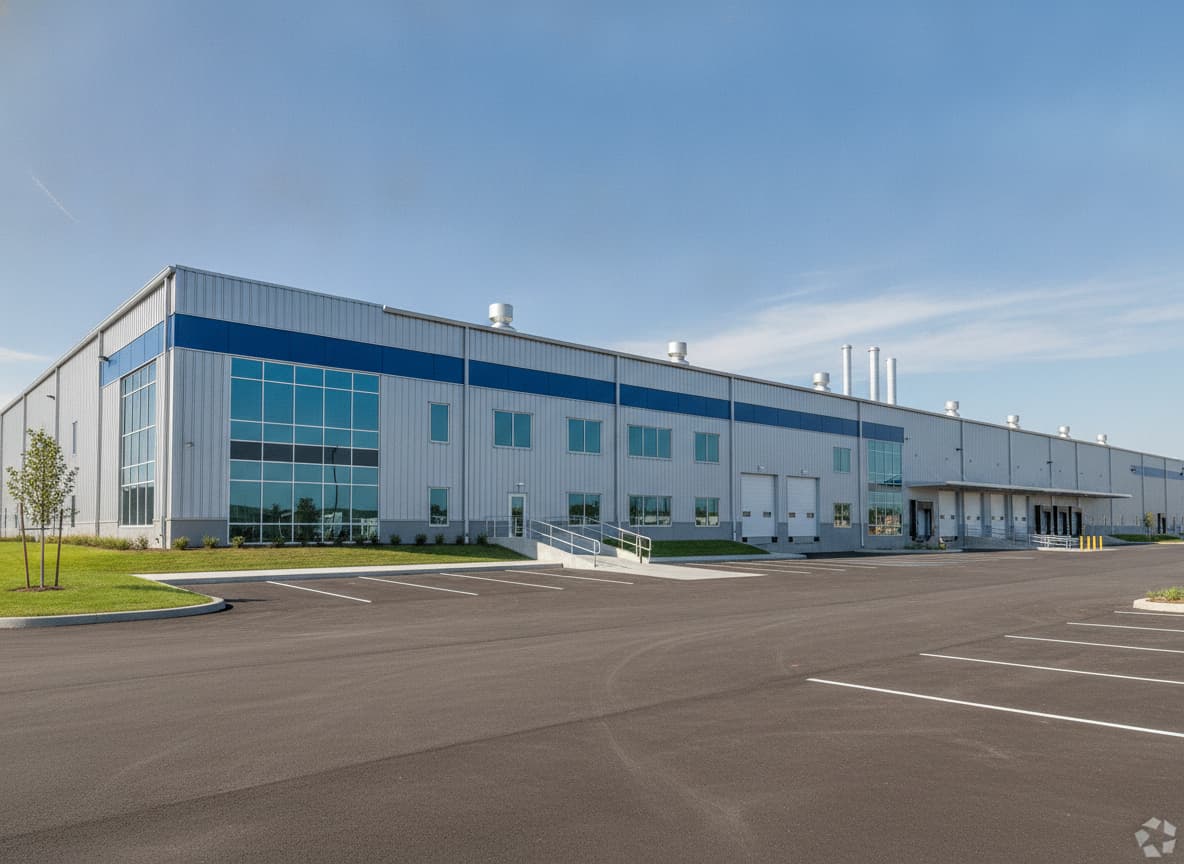 Commercial Real Estate Financing
Industrial property loans built around how you actually use the building
Whether you manufacture, warehouse, run R&D, or hold industrial as an investment, North Bay Capital shops the right structure for you, from low-down SBA 504 for owner-users to conventional and DSCR financing for investors.
North Bay Capital arranges financing for industrial real estate, from manufacturing and flex space to R&D and light industrial. We match owner-users with low-down, long-fixed SBA 504 financing and place investor deals with conventional and DSCR lenders.
Programs we broker
The options under industrial loans — and the right fit for each.
Owner-User Industrial via SBA 504
Buy your warehouse or manufacturing facility with 10% down and a fixed 25-year second.
The SBA 504 is built for owner-users buying industrial real estate they'll occupy at least 51% of. A bank funds roughly 50% of the project, a CDC (Certified Development Company) funds about 40% through a debenture sold to the bond market, and you put down around 10%. The CDC piece carries a fixed rate locked for 25 years, which is the single best feature of this program for industrial buyers — your largest occupancy cost stops floating.
I run 504 deals on warehouses, distribution buildings, light manufacturing, cold storage, and clean industrial flex. Eligible costs roll up the building, land, certain FF&E with useful life over 10 years, soft costs, and even some renovation. Two-step closings are normal — the bank funds first, the CDC takes out its piece after C of O on construction deals.
- Buying the warehouse you've been leasing
- Acquiring a light manufacturing facility
- Building a new distribution center
- Consolidating operations into one industrial campus
Owner-User Industrial via SBA 7(a)
One loan, one closing — real estate plus working capital and equipment in the same package.
The 7(a) is the more flexible cousin of the 504. Where 504 is structured around the real estate, the 7(a) lets us wrap real estate, equipment, business acquisition, partner buyouts, debt refinance, and working capital into a single 25-year loan. For an industrial owner-user who needs the building plus a forklift fleet, a CNC, or cash to ramp up production, that simplicity is hard to beat.
Rates on 7(a) are usually variable (Prime + a spread) with a 25-year amortization when real estate is the majority of the use of proceeds. Maximum loan is $5 million. Same 51% owner-occupancy rule applies. The trade-off versus 504 is the rate structure — you give up the long fixed rate, but you gain the ability to fund everything in one shot.
- Buying a building plus the equipment inside it
- Industrial acquisition with a working capital cushion
- Refinancing a balloon and pulling cash for expansion
- Partner buyout combined with real estate purchase
Investor Industrial via Bank / Portfolio
Conventional financing for warehouses, flex, and small bay industrial held as investment.
When you're holding industrial as an investment — single tenant NNN warehouse, multi-tenant flex park, small bay industrial condos — the lender pool shifts to banks and portfolio shops sizing the loan to the property's net operating income. We're underwriting to DSCR (typically 1.25x or better), debt yield, and tenant quality. Industrial generally pencils well right now because rent rolls have stayed firm and tenants tend to stick.
Expect 25 to 30 percent down, recourse on smaller deals, and non-recourse available once you're north of roughly $5M with strong sponsorship. Most banks fix the rate for 5, 7, or 10 years over a 25- or 30-year amortization. Portfolio lenders are where I go for quirky deals — short lease terms, environmental hair, or owners who don't want to personally guarantee.
- Stabilized single-tenant warehouse purchase
- Refinancing a maturing balloon on a flex park
- Cash-out refinance on a long-held industrial asset
- Multi-tenant small bay acquisition
Flex Space / Light Industrial Loans
Financing for the office-warehouse hybrids that don't fit a clean box.
Flex space — a tilt-up with office in the front and warehouse in the back, or multi-tenant business park units around 20–40% office finish — is its own underwriting category. Some lenders treat it like office, some like industrial, and the rate and proceeds difference between those two buckets can be material. Part of my job is shopping the deal to the lenders who code it correctly so you're not overpaying for the office component.
These deals work for both owner-users (SBA 504 / 7(a)) and investors (bank / portfolio / DSCR). The build-out percentage, ceiling height, dock vs. grade level access, and parking ratio all drive how lenders see the asset. I'll tell you upfront how the property is likely to underwrite before we waste anyone's time.
- Buying a flex unit for your contracting business
- Multi-tenant business park acquisition
- Refinancing a flex property out of a hard money bridge
- Cash-out on a long-held flex asset
R&D Facility Loans
Financing for life science, lab, and research-and-development industrial buildings.
R&D is industrial's specialty cousin. We're talking lab build-outs, biotech and life science space, cleanrooms, and engineering campuses with serious electrical, HVAC, and sometimes hazmat infrastructure. The improvements are expensive, the tenant pool is narrower, and lenders price that risk in. For owner-users (a growing biotech buying their own facility, for example), SBA 504 still works well because the long-term fixed second meaningfully de-risks a high-improvement property.
For investor R&D — single-tenant net leased to a credit life science tenant — we're usually in the bank or insurance company / CMBS world depending on size. Underwriting leans hard on tenant credit, lease term remaining, and rollover risk. I'll size the deal honestly upfront so you know whether the rent supports the price you're considering.
- Biotech buying its own lab building
- Single-tenant credit life science acquisition
- Refinancing an R&D campus with a long lease in place
- Build-to-suit takeout financing
Industrial Construction Loans
Ground-up warehouse, manufacturing, and distribution construction with a clear path to permanent.
Industrial construction divides into two tracks. Owner-users build under SBA 504, which lets you finance land, hard costs, soft costs, and certain long-life equipment with the same 10% down and 25-year CDC fixed second as an acquisition. The construction interest-only period typically runs 12 to 18 months, and the 504 takeout funds at C of O — so there's a planned path from dirt to permanent in one engagement.
Investor or speculative industrial construction is a different animal. Bank construction lenders look at sponsor experience, pre-leasing, GC strength, and market vacancy. Pricing is variable during construction (Prime or SOFR plus a spread), and the permanent takeout — bank, life co, or agency-like — is lined up before the construction loan closes. I run both tracks and tell you which one fits before we start spending money on plans.
- Owner-user ground-up warehouse
- Speculative small bay industrial development
- Build-to-suit for a known tenant
- Expansion of an existing manufacturing campus
Calculators for this loan
What people ask before they apply
What is an industrial property loan?
It is commercial real estate financing for industrial-use buildings: manufacturing plants, warehouses, distribution centers, flex space, and R&D or light-industrial facilities. The right loan depends mainly on whether your own business occupies the building (owner-user) or you are holding it as a leased investment, because lenders underwrite those two situations very differently.
Is an SBA 504 loan a good fit for buying an industrial building?
For owner-users, it is often the strongest option. SBA 504 lets you put down as little as 10%, keeps the CDC portion at a long fixed rate, and is specifically designed for businesses occupying the property they finance. Manufacturers are a particularly good fit, and small manufacturers can access a larger SBA debenture, up to $5.5 million. Verify your eligibility and current figures for your scenario.
How much down payment do I need for an industrial property?
For an owner-user using SBA 504, the down payment is typically 10%, rising to about 15% for special-purpose properties or startups. Conventional owner-occupied loans often go up to roughly 80% loan-to-value, meaning around 20% down. Investor (non-owner-occupied) deals usually require more equity, commonly 25-35% down depending on the property's income and the lender.
What is the difference between owner-user and investor industrial financing?
An owner-user occupies and operates out of the building, so lenders can lean on the business's cash flow and offer programs like SBA 504 with low down payments and high financing. An investor leases the building to tenants, so lenders underwrite the property's net operating income, often using a DSCR (debt-service-coverage-ratio) test, typically around 1.20x to 1.25x. The two paths have different down payments, rates, and documentation.
What occupancy is required to qualify as an owner-user under SBA 504?
For an existing building, your business generally must occupy at least 51% of the space. For ground-up construction, you must occupy at least 60% at the outset and plan to grow into more over time. The remaining space can be leased to tenants, which is one reason owner-users sometimes finance a slightly larger building than they need today.
How is financing for flex and R&D space different from a plain warehouse?
Flex and R&D space mixes office, warehouse, and sometimes lab use, so lenders weigh the office-to-warehouse ratio and the quality and specialization of the build-out. General-purpose, re-leasable space tends to finance more easily than highly specialized special-purpose space. Because lender appetite varies, shopping the deal across multiple lenders matters more for this property type.
Why use a mortgage broker instead of going straight to a bank for an industrial loan?
A single bank offers one set of programs and one credit box. As a brokerage, North Bay Capital shops many lenders, banks, credit unions, CDCs, and debt funds, and structures SBA 504, conventional, and DSCR options side by side. That means you see real trade-offs in down payment, rate, and fees, and we coordinate the moving pieces, including the dual-lender structure of an SBA 504, on your behalf.
Can I finance a ground-up industrial build for my own business?
Yes. Owner-users can use SBA 504 for new construction, with a 60% initial occupancy requirement and a plan to occupy more over time. Conventional construction-to-permanent financing is also available, especially for strong borrowers or projects above SBA limits. Call North Bay Capital to talk through which structure fits your timeline and budget.
Jesse Gonzalez, President & Founder
NMLS #278103 · CA DRE #01855372 · Last reviewed June 24, 2026
Talk through your industrial deal with someone who picks up the phone
Tell us about the building and how you will use it, and we will lay out the real options, from SBA 504 for owner-users to conventional and DSCR financing for investors. Call Jesse Gonzalez at North Bay Capital at 707-595-5393 or email jesse@northbaycap.com for a straight answer on what fits your scenario.